Like BBD said spread the love. Working your hands or feet has more to than just Rudiments... you have to deal with combos... coordination around the kit... orchestration on/around the kit... ear training... styles/genre... Control studies... 4-way Independence/Interdependence... Polyrhythms... yada, yada
This really helped me get mine together recently because I need to be about the business.
fretai03 posted it from a New Zealand drum forum. It is pretty serious but you can us it as a guide.
Original Routine Post Starts HereThis is NOT my routine but it helped me get mine sorted. Hopefully it helps you get yours done too. Just change whatever you need to make relevant to you.
The original thread & author (Benji) can be found here:
http://drums.2.forumer.com/index.php?showtopic=1349&st=45Okay, here goes. Each individual practice session plan, followed by some information about all the areas in it, why I practise those things in that group, and any additional thoughts I feel should be mentioned.
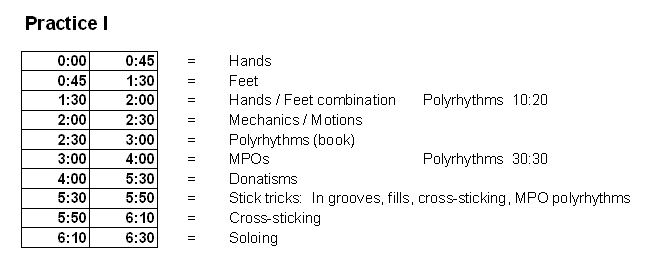
This is definitely the 'super-session'. It's the longest, and most difficult. There is a good amount of work on my hand and foot technique at the beginning, but the main purpose is really pushing mental and physical limits. Even practising hand and foot technique is by no means easy, if you're really pushing yourself you should feel yourself working physically, but not enough to tire you so that you cannot continue the session at an efficient level. It's expanding your limits, not pushing past them and tiring yourself.
Because of the length of this session, I would doubt that I will be able to do this more than once a week down in Wellington, though I would like to. But because of the difficulty and intensity, once a week would be enough. A practice session like that is very tiring mentally, and I don't think I would be able to do that every day. You need to do different things to stay energised and mentally fresh - so this is the weekly super-session where I really go for it.
It should be noted that while what I would be doing is very technical, musicality remains a criteria that must be met.
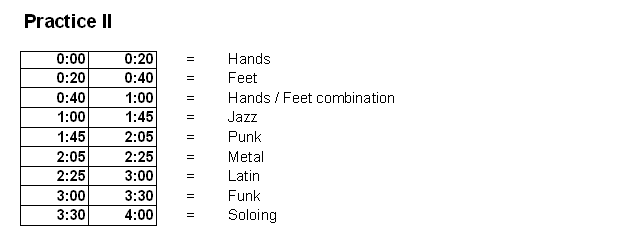
The technique practice at the start of this session is little more than a warm-up and maintenance. From there, the emphasis of this session is more on music. The first practice session is mainly technical / complex, and while the skills practised can be applied in a musical setting, that is not the focus. Whereas this session, is working on playing those genres. Really getting into the mindset of what to play in each genre. How I feel when I play punk is not how I feel when I play jazz. How I feel when I play rock is not how I feel when I butcher Latin. This practice session is really focussing on genre-specific playing, and maintaining a high level of groove in each genre.
Appropriate grooves, appropriate fills - particular themes to bring into the playing in each genre. That's not to say I don't let loose, but when you do, it still has to retain the style of the genre you're practising within.
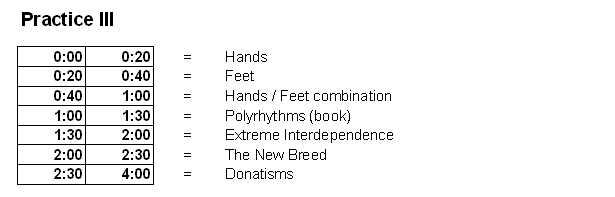
This session has some similarities to the first in the sense that it focuses on advanced playing, but it is more specific. It works on independence, interdependence and advanced coordination in particular. As I've said before, I'm really big on aiming for ambidexterity and 'perfect' coordination - this practice session is working towards that, really.
Workings out of the polyrhythm book are only two-line exercises, but this can be reversed, played on feet, reversed, split up between feet and hands - and you can do two sets at once, etc. You take it as far as you want. Just one example of how a straight two-limb melody can be used to work on both sides of the body, and cross over and the like.
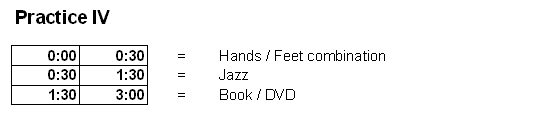
This would be a pretty light practice session, comparatively - but that doesn't mean you can't have intense jazz, or take working out of books and DVDs to higher levels of intensity also. It wouldn't be anywhere near as mentally or physically draining as other sessions though, that's for sure. And that's partly its purpose.

I may be doing a jazz course, but that doesn't mean it has to feature in all my practice sessions - this is also set out like the above session - same warm-up and maintenance of technique at the start, and same overall length. But it's just on whatever book or DVD I want to work on. As I've said many times, you take things as far as you want to.
So, there are the five practice sessions. Now, some things to note:
This is not all the practice I would do. As doing a jazz course, there would be things I would need to go home and work on, or if the band I'm starting gets going, I would need to practise things for the songs played - what I'm saying is, there would be extra material I would need to go over.
But that doesn't interfere with planned practice. So I would surely do more practice than the above sessions - and as everything is equally important in its own right, it is equally important I get everything done. It is important to me that I stick to my practice sessions, because that will help me take my own drumming where I want to go. It is important I work on the material I need to for my course, because if I don't, I won't pass. It is important I work on things for my band, because that will be another important feature of my life.
Of course I would have unplanned practice sessions, and of course I would still jam. These are just the planned sessions, and I just wanted to make it clear this would not be all I did.
Another point - when I say I'm working out of books or DVDs, it doesn't necessarily mean going through the exercises verbatim. For example, when I was working out of the John Blackwell DVD the other night, I worked on the cross-stticking pattern he plays on the cymbals, while performing stick tricks - and it gave me an idea for my own one. So it spurred me to go off on a related tangent and practise that.
Working out of books and DVDs does not restrict me to only playing what is in the book or DVD - they're solid, topical resources, where with every exercise you practise from it, you can get more ideas for your own.
That's about it. I hope the above benefits people in some way.